Apractical MTTR, recurrence, spare-parts and FAT/SAT framework for HDPE/PPbottles, jerry cans, drums, IBC liners and large hollow products.
Executive answer
A useful reliability claim must define the downtime clock, classify the stop, separate waiting from active repair, measure recovery to sustained good output and monitor whether the verified cause returns. 'Motion restored' and 'ticket closed' are not complete recovery evidence.
1. Why this pain pointmatters
Downtime in extrusion blow molding is morethan missed output. A night shift may be unable to diagnose the event, alarmtext may be unclear, remote access may be unavailable, the critical spare mayhave no usable part number, or restart may create scrap and another qualityrelease. If the same fault keeps returning, a 'closed' ticket has moved theproblem rather than solved it.
A machine purchase should therefore notrely on nominal speed or an unqualified uptime percentage. Planned productiontime, stop classes, quality release and data boundaries must be consistentbefore any comparison. Define the loss clock first; then discuss alarms,diagnosis, spares, training, maintenance and service.
2. Do not stop the clock whena motor moves again
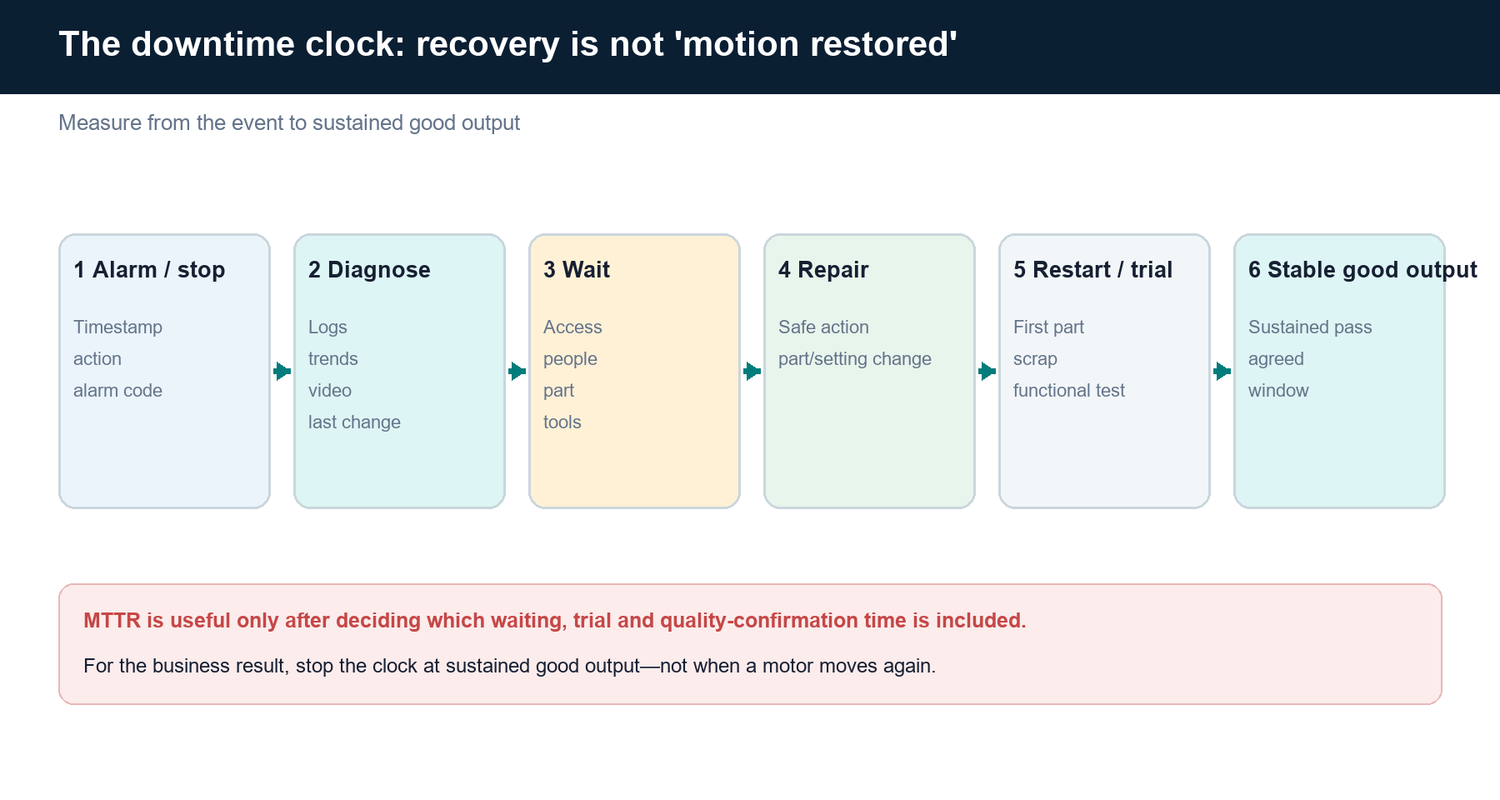
Stage | Record | Common error |
Alarm / stop | Exact time, stopped action, alarm code | Operator narrative without a timeline |
Diagnosis | Logs, trends, video and last change | One symptom is treated as one certain cause |
Waiting | Remote access, person, part and tool delays | All elapsed time is called repair time |
Repair | Safe action, part/setting change and owner | The record says only 'resolved' |
Trial / release | First part, scrap, functional test and stable window | Clock stops when motion returns |
3. Five KPIs that can survivea purchase review
KPI | Definition / formula | Boundary note |
Unplanned downtime rate | Unplanned stop time ÷ planned production time | Separate changeover, no demand and planned maintenance |
MTTR | Total recovery time for qualifying repair events ÷ event count | State whether waiting, trial and quality release are included |
MTBF | Qualifying operating time ÷ failure-event count | Use consistent failure classes and a minimum stop threshold |
Recurrence rate | Share of incidents where the same verified cause returns in the monitoring window | Same alarm text is not automatically the same root cause |
Stable-good recovery | Event start to sustained good output in the agreed window | Freeze product, mold, material and quality gate |
4. A transparent ownercalculation
The following figures show the arithmeticonly. They are not an industry average, customer case or Ascendia performanceguarantee. A real project must replace them with 8-12 weeks of stop records,demand and contribution margin.
Input | Illustrative value | Why it must be replaced |
Current good output | 5,000 units/day | Use stable actual good output, not theoretical cycles |
Current availability | 92% | Align planned time and stop classes |
Production calendar | 300 days/year | Use actual schedule and demand |
Downtime scenario | 8% → 4% | Scenario only, not an equipment promise |
Contribution margin | CNY 0.55/good unit | Do not use sales revenue; buyer finance confirms |
Step 1 - implied 100%-availability capacity
5,000÷ 0.92 = about 5,435 good units/day
Step 2 - potential recovered good output
5,435× 4% × 300 = about 65,217 good units/year
Step 3 - opportunity value
65,217× CNY 0.55 = about CNY 35,869/year
Calculation boundary
If demand is insufficient, downstream cannot accept the output, or the same recovered hours are already valued through overtime, outsourcing or delivery loss, the opportunity value falls and may approach zero. Do not double count.
5. Equal downtime hours canhide different risk
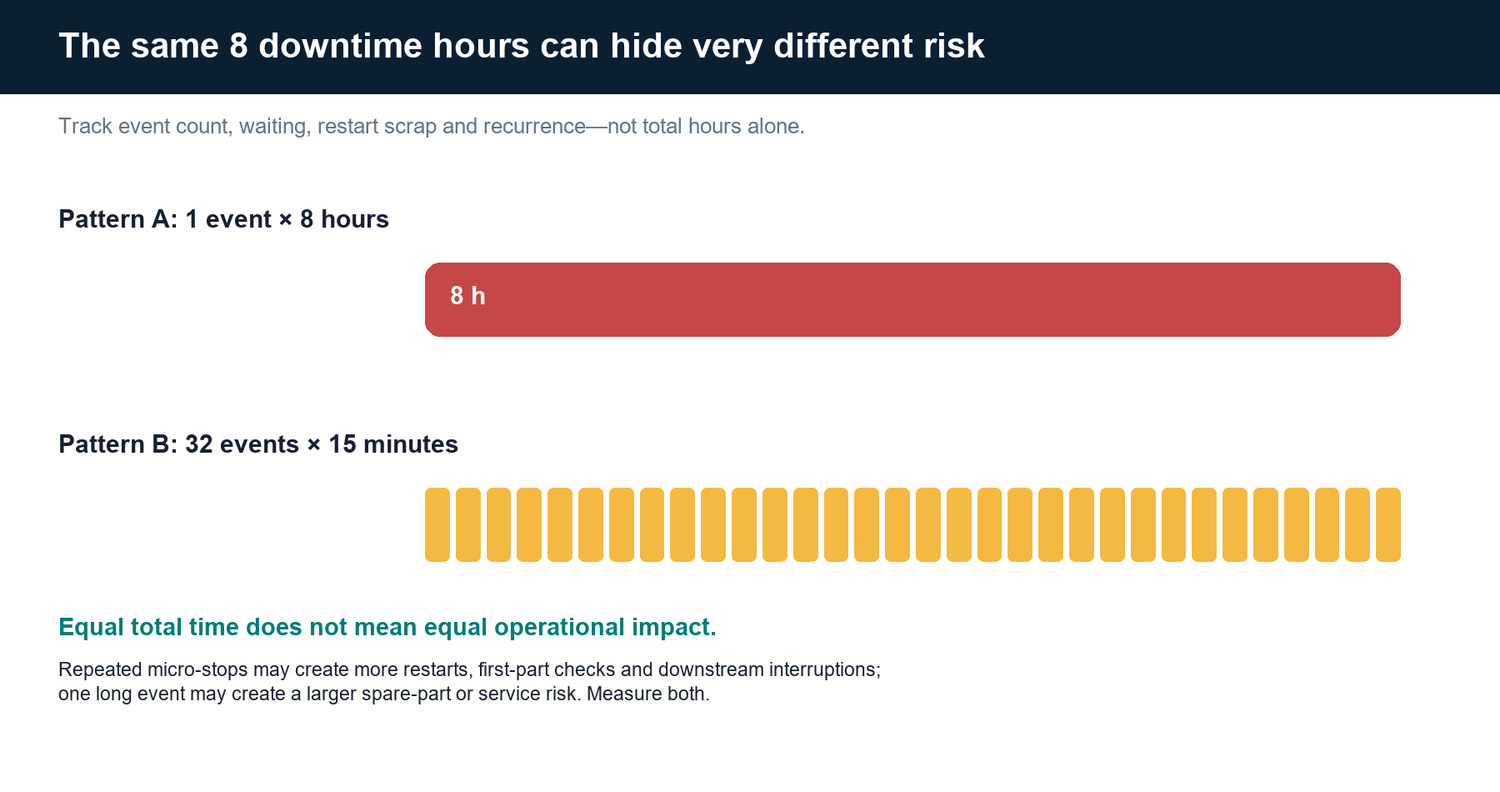
One long event may expose critical-spare,external-engineer or high-risk repair dependence. Repeated micro-stops maydisrupt downstream work and multiply restart scrap and first-part checks. Totalhours alone are insufficient, and neither pattern is automatically moreexpensive.
6. Classify the stop beforediscussing a machine solution
Stop class | May include | Minimum evidence | Do not assume |
Equipment | Sensor, heater, valve, pump, PLC/drive | Alarm, timeline, parameter trend, maintenance history | One alarm proves a machine-design defect |
Mold / process | Sticking, flash, cooling, blow pin, first part | Product/mold/cavity, sample and last change | Every quality stop is caused by the machine |
Material / auxiliary | Feed, mixing, grinding, air or water | Batch, pressure/temperature/flow and interlock record | Replacing the main machine fixes it |
Organizational | Waiting for QC, forklift, packing or people | Stop code, owner and queue/wait time | All time belongs in equipment failure rate |
7. What must remain after theticket is closed
· Event identity: machine serial,product, mold/cavity, material lot and software/recipe version.
· Timeline: alarm, acknowledgement,remote access, technician arrival, part arrival, motion restored, first goodpart and sustained good output.
· Cause and action: verified rootcause, temporary action, permanent action, owner and due date.
· Verification: reproductioncondition, post-recovery run window, quality result and recurrence-monitoringperiod.
· Safety: heated, pressurised,hydraulic-energy, electrical or accumulator-head work belongs to qualifiedpersonnel; this article does not instruct remote disassembly.
8. Where Ascendia machinefamilies enter the discussion
Ascendia should not promise a low failurerate or recovery time before reviewing the product and site record. Theresponsible product insertion is to map product, mold, material, output, site,utilities and service boundary to a machine family and verification checklist.
Ascendia family | Current catalog positioning | Downtime / recovery review |
ASCENDIA-5L / 12L | Continuous-extrusion, double-station families for smaller HDPE/PP containers | Product/mold changes, alarms, heaters/sensors and downstream interface |
ASCENDIA-25L S / D | Single- or dual-station families for jerry cans and industrial drums | Mold, trimming, leak test, cooling and downstream stop boundary |
ASCENDIA-30L-250L | Accumulator-head families for medium and large hollow products | Hydraulic/accumulator/heating/cooling, critical spares and safe recovery |
ASCENDIA-1000L | Accumulator-head family for IBC liners, tanks and ultra-large hollow products | Site, utilities, handling/downstream, service and critical-spare path |
9. The pre-quotation downtimeand service evidence pack
Evidence group | Minimum buyer input | What it prevents |
Product / mold | Photo/drawing, material, weight, mold/cavity and quality tests | Selecting a machine from capacity alone |
Production boundary | Shifts, planned time, demand, downstream capacity, changeover and planned maintenance | Charging no-demand and organizational waits to equipment |
Stop record | Four weeks of codes, start/end, owner, output and scrap | Replacing evidence with 'it stops often' |
Recovery data | Alarm, trends, video, last change and first/stable-good times | Closing a ticket without verification |
Site / service | Language, time zone, network authority, people, critical spares and substitutes | Calling one WhatsApp number a service plan |
10. Suggested FAT/SAT andrecovery acceptance logic
· Freeze product, approved material,mold/cavity, target weight, quality tests and continuous-run duration.
· Define planned production time,permitted stops, stop codes, event threshold and denominator.
· Verify alarm readability, log/trendexport, version/recipe backup, restore point and controlled network authority.
· Test recovery only in technicallyand safely approved controlled scenarios; do not create a high-risk fault fordemonstration.
· Record event-to-first-good andevent-to-sustained-good time, trial scrap and downstream resynchronisation.
· Put critical-spare part number,quantity, lead time, substitute, storage condition and owner in the projectfile.
· Approve a reliability or savingsclaim only when raw records reproduce the result and recurrence monitoring iscomplete.
Ascendia CTA
Send the product/mold details, material, shifts, planned time and four weeks of stop records. Ascendia Industrial Solution can help structure a downtime-loss worksheet, minimum remote-diagnosis data pack and FAT/SAT recovery checklist before machine configuration and quotation.

